Review
Far Cry 5 Review, Spoiler-Free: Hope County and the Seeds
Ubisoft moved Far Cry to rural Montana and built its open world around a doomsday cult. The result refines nearly everything from Far Cry 4 and shakes up the formula along the way.
Released March 27, 2018Reviewed on Xbox One XAlso on PlayStation 4, PCDeveloper Ubisoft Montreal, Ubisoft TorontoPublisher UbisoftPrice at launch $59.99 USD
Far Cry 5 shakes up a formula that had not yet gone stale, and the shake-up works. It borrows from Far Cry 3, 4 and Primal, from Ghost Recon Wildlands, from BioShock Infinite’s religious imagery, and even from State of Decay’s house-to-house scavenging through rural America. The mix feels fresh. This review avoids story details beyond the opening setup.
The opening
The game begins with an unnamed deputy entering Hope County, Montana, the series’ first North American setting, to arrest “The Father”, Joseph Seed, leader of the Project at Eden’s Gate. Cult members jeer from every side of his compound. A few scripted minutes later everything falls apart, and Joseph announces “The Reaping”, the start of the end times he has prophesied.
The escape through dark woods is cleverly built. It steers the player towards a handful of key points in the open world so subtly that the guide rails never show, which is rare in a scripted introduction.
The first hour has three parts: the escape, a loose tutorial (a basic character creator with eight faces, a few open-world activities, an explanation of the county), and then freedom. Hope County has three regions, each ruled by a different member of the Seed family, each tightening the cult’s grip in its own way. Damaging the cult in a region fills its Resistance meter, and the long-term goal is Joseph himself. Anyone who played Ghost Recon Wildlands will recognise the structure, even though different Ubisoft studios made the two games.
Montana in 4K
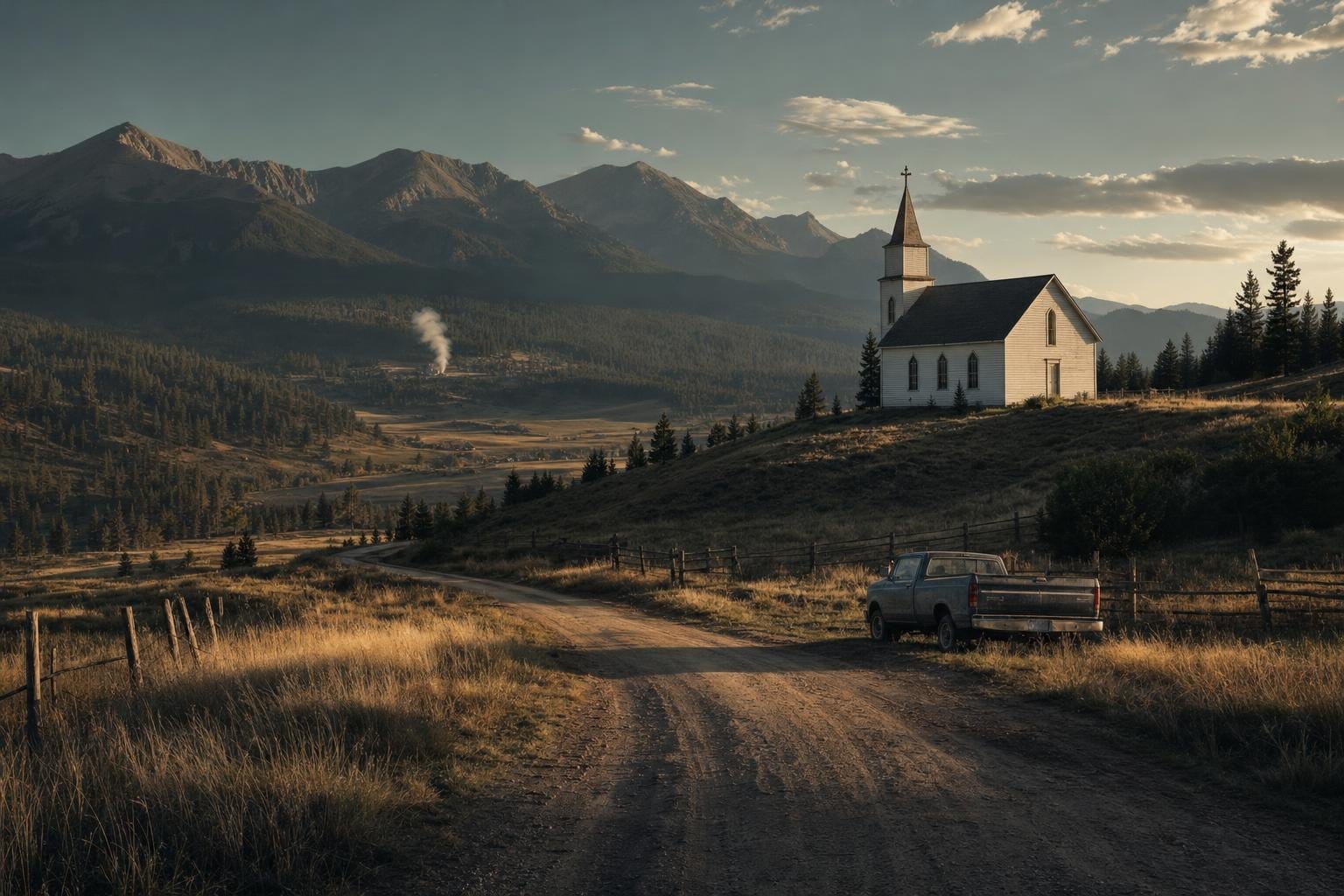
On Xbox One X in 4K, Hope County is stunning. Pine needles and individual blades of grass seem countable. Sunrises and sunsets silhouette the scenery and throw real glare without relying on old-fashioned lens flare. It is one of the most visually striking open worlds on console.
Big open-world maps often feel empty. This one does not. There is almost always something happening nearby, and the best moments come from the world itself. A farm freed from the cult, golden light over a field of tall crops, split-rail fences, stacked bales and a small tractor: it feels peaceful for a moment.
Then Far Cry happens.
A world that fights itself
Over the next hill, a cult patrol is fighting Resistance militia. A heavily armoured cultist with a light machine gun tips the fight, an ATV explodes, and two cultists are left standing, catching their breath. Then a brown bear charges out of the brush, kills one, chases the other down the road, kills him too and wanders back into the trees.
None of it is scripted. Patrols, militia, wildlife and player keep colliding in ways nobody planned, and that unpredictability is what fills the map. Every patrol stopped, supply run destroyed or hostage freed also provokes the cult, which commits more resources to holding its region. How it responds is best discovered in play.
Combat
The series’ smooth gunplay returns; players coming from twitchier shooters may want to adjust input sensitivity. The deputy starts with a sidearm and one primary weapon, with more slots unlocked through progression. Shops sell new weapons as the Resistance grows across the regions, and nearly every gun takes attachments: scopes, suppressors, extended magazines.
Prestige weapons cost much more but appear to be cosmetic variants rather than stronger guns. Silver bars, the premium currency, were expected to offer early access to them; the store was not active before launch.
Fire spreads dynamically again, a system that goes back to Far Cry 2 and is bigger and more dangerous here.
Guns for Hire are the standout addition. Some join through story missions and some are met in the world. Animal companions and human specialists each bring their own skills, and fights are better with one of them along.
Skills through challenges
Far Cry 3 introduced levels and skills. Far Cry 5 changes how points are earned: mainly through challenges, simple one-off tasks such as a set number of kills with a weapon type. They pay out a healthy number of points per hour, with a catch. A player who sticks to one style runs out of easy challenges, while chasing challenges can push a player into styles they do not enjoy. The best approach is to keep a reliable main weapon and branch out with a second.
Fifty skills sit in five categories. Some require a prerequisite, but the tree leaves plenty of freedom. Individual skills feel small at first and add up to a very capable character.
Side activities
Hope County has hundreds of side missions and activities, from the series’ standard outpost liberations to smaller jobs. Prepper Stashes are the highlight: short environmental puzzles built around a hidden supply cache. A typical one has a flooded storeroom that needs a pump, a pump room locked behind a key, and a key hidden behind another door with no key, and the solution means working backwards through the steps. The cash and gear are welcome, but the real prize is the survivalist magazines inside, each worth skill points. Few take more than a few minutes.
Elsewhere there are locals to help (herding cows, dealing with a problem bear), vehicle races, fishing, hunting, hikes through the backcountry, and cult convoys carrying supplies or prisoners.
Co-op and Far Cry Arcade
Co-op is promoted heavily, with the whole campaign playable with a friend. Far Cry Arcade, the next generation of the series’ map editor, adds assets from Assassin’s Creed and Watch Dogs, and in-world arcade machines and posters lead into its modes. Both were disabled before launch and were not part of this review.
The story, without spoilers
One note on tone: the enemy is a fanatical cult convinced it is carrying out God’s will, and its leader preaches almost entirely from the Book of Revelation. The game is full of religious imagery deliberately twisted.
The setup resembles Ghost Recon Wildlands: dropped into a region, free to take on its rulers in any order, with the story moving at the player’s pace. The tone is very different. In Wildlands the cartel knows it is evil and enjoys it. In Far Cry 5, Eden’s Gate believes every act is righteous and prophesied, and that conviction is what makes it unsettling.
The verdict
Far Cry 5 refines almost everything from Far Cry 4, with very few bugs and a world that feels true to the rural northwestern United States. Fifteen to twenty hours spent in a single region still left two regions untouched, which says a lot about how much there is. For anyone who enjoyed the earlier games, this is the series at its most confident. Players uncomfortable with heavy religious themes should know what they are walking into.
Questions readers ask
Where is Far Cry 5 set?
In the fictional Hope County, Montana, the first Far Cry set in North America. The county is split into three regions, each run by a member of the Seed family.
How do skill points work in Far Cry 5?
Mostly through challenges: one-off tasks such as getting a number of kills with a weapon type. Survivalist magazines found in Prepper Stashes also give skill points. Fifty skills sit in five categories.
Can you play Far Cry 5 in co-op?
Yes. The campaign supports co-operative play, and Far Cry Arcade adds a map editor and community-made modes using assets from other Ubisoft games.