Feature
More Horizon Zero Dawn, Just Not a Direct Sequel
Horizon Zero Dawn tells a whole story in one game. That is its strength, and the reason a straight sequel is the riskiest way to continue it.
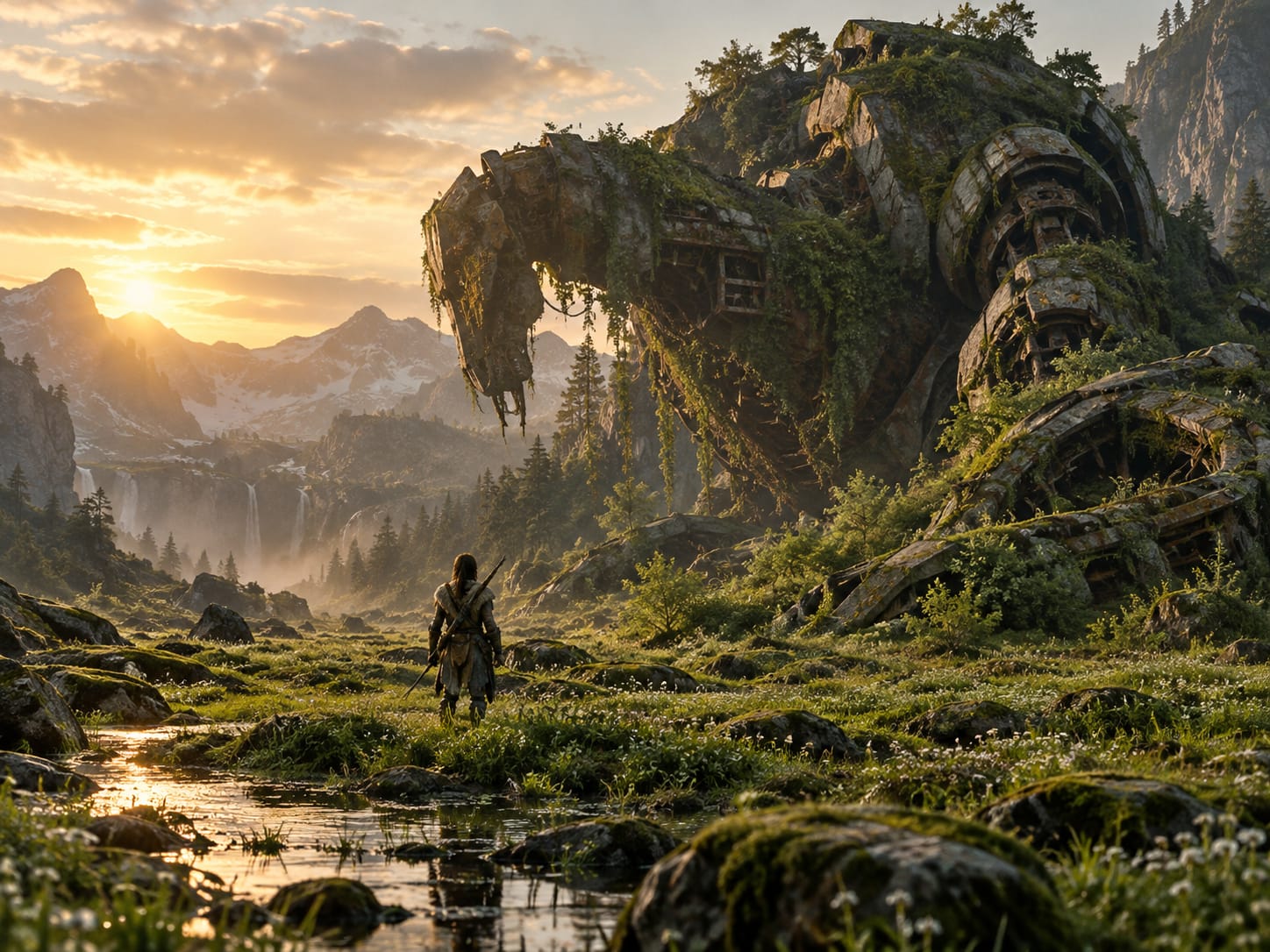
This feature contains major plot spoilers for Horizon Zero Dawn.
Horizon Zero Dawn deserved better timing. It is excellent in story, visuals and play, yet in 2017 it ended up second in many players’ minds. The Legend of Zelda: Breath of the Wild, similar in many ways, arrived three days later. Both games received six nominations at The Game Awards, and some critics called Horizon one of the best games of the generation. It was overshadowed anyway.
A world that holds together
The biggest surprise is how believable Guerrilla Games’ world is. Humanity is thrown back to a new dark age by a scenario close to the warnings Elon Musk has given about runaway machines, then slowly rebuilds on top of technology it no longer understands. The story, led by John Gonzalez (previously lead creative designer on Fallout: New Vegas at Obsidian), borrows some of the best ideas from science fiction in games and other media and makes them its own.
Aloy’s path is familiar. She proves herself at the Proving and is named a Seeker, free to leave her tribe’s borders, much as Commander Shepard becomes a Spectre in the first Mass Effect. She then uncovers how GAIA and its subordinate functions were meant to terraform and repopulate the Earth before it all went wrong. That thread recalls I, Robot and The Terminator, and most of all the struggle between Vision and Ultron in Avengers: Age of Ultron. Finally she defeats the rogue subfunction HADES, as heroes do. The difference is that this arc is not spread over a trilogy. It is all in one game.
Aloy is the other strength. Mass Effect and the modern Fallout games hand the player a blank protagonist to fill with their own values. Aloy is a written character: an outcast fixed on finding her mother while the greatest mystery in history unfolds around her. There are no branching paths. The game has a clear arc with a beginning, middle and end.
The sequel problem
Games are a hit-driven business, and with more than four million copies sold, more Horizon was always going to happen. A finite story like this one invites sequelitis, the escalation that pulls a franchise off course. The best reveals have already been used, and apart from the final minute, the story feels finished.
That leaves room for more Horizon that is not Horizon Zero Dawn 2. Three possibilities stand out.
Option one: a Sylens spinoff
Lance Reddick’s Sylens is one of the high points of the game. His backstory is drip-fed until his motives finally make sense, but much of it arrives through monologue. Aloy is almost pure in her intentions; playing her opposite would be a sharp change of tone.
Naughty Dog’s Uncharted: The Lost Legacy showed that smaller standalone games built around secondary characters can work. A Sylens game could cover his discovery of HADES, his part in creating the Eclipse and his first meeting with Aloy: the same events seen through a darker lens.
Option two: a series about GAIA
The reveal of Operation Enduring Victory and Project Zero Dawn is one of the most shocking sequences in the game. It unfolds through holograms, text logs and audio logs, and the scenario is cold but plausible. Many players hunted down every optional log to fill in how humanity ended. The choice offered to staff after the Zero Dawn briefing (take part, accept indefinite detention, or choose medical euthanasia) stays with players long after.
A game set in that era would be difficult, but a live-action or animated series would suit it well. Scientists race to build an AI that can stop the biomass-eating robots, terraform the planet, create new life and preserve human knowledge, while the human drama plays out around them. Ted Faro, a sort of reverse Tony Stark, goes from building green robots with Elisabet Sobeck to military robotics and becomes the world’s first trillionaire. Among the Alphas, Travis Tate stands out, with a religious upbringing, a rebellious past and an unexplained incident involving the Sterling-Malkeet corporation. The background issues, such as what happened to free speech as technology raced ahead, would give such a series plenty of depth.
Option three: an Enduring Victory shooter
Guerrilla could also return to its roots. Operation Enduring Victory is the other side of Zero Dawn. To buy time for the people trying to save humanity’s future, General Herres told soldiers that Zero Dawn was a weapon that could stop the Faro Plague. They were sent to fight a war they could never win.
Knowing the ending does not ruin a game. Halo: Reach proved that. An Enduring Victory shooter could follow a US Army soldier through the two-year campaign, with the squad focus of Halo 3: ODST, the large spaces and huge machines of the Decima engine, and a slowly revealed conspiracy in the spirit of Philip K. Dick’s The Man in the High Castle as the soldier learns what the mission really is.
Still thinking about it
2017 was one of the strongest years in game history. Horizon Zero Dawn’s story still stands among the best of modern games, and the demand for more of it is easy to understand.
The question is only how to give players more without breaking a story that already ended well.