Review
Remothered: Tormented Fathers Review: Horror Without Monsters
Stormind Games built a survival horror game around hiding, listening and luring rather than fighting. Six hours long, it rarely lets the tension drop.
Released January 30, 2018Reviewed on PCLater on PlayStation 4, Xbox OneDeveloper Stormind GamesPublisher Darril ArtsPrice at launch $14.99 USD
Resident Evil and Silent Hill in a dark room at midnight shaped what many players expect from survival horror. Years of horror films and games later, few things still scare. Remothered: Tormented Fathers manages it, and does so without a single monster.
The game launched in Steam Early Access in time for Halloween 2017. Early Access usually helps pay for development, but here the project was already fully funded; creator Chris Darril used it to involve the community. The Early Access build held around two thirds of the game. The full release arrived on January 30, 2018.
Built on Unreal Engine 4
The recommended specification, a Core i7, 8 GB of RAM and a GTX 1060, is high for a small horror game. The reason is Unreal Engine 4, which Stormind used to the full: advanced AI, cinematic scenes, a sophisticated audio engine. On a well-overclocked i7-4790K and GTX 1060 at 1080p, the game defaults to Ultra and holds 60 fps with V-Sync, and passes 150 fps without it. Lower hardware will likely cope too, depending on resolution.
Ultra is clearly how the game is meant to be seen. At High, textures turn muddy; Medium and Low are best avoided. On Ultra, the dark, grimy, atmospheric house pulls the player in.
The sound of fear
The score is by Nobuko Toda, whose credits include Final Fantasy, Halo and Metal Gear Solid 3, 4 and Peace Walker. The music changes tempo as the threat rises, and it does most of the work in keeping the player’s pulse up. The first jump scare is strong enough that a break afterwards feels necessary.
Mouse and keyboard controls are smooth, as is a controller. Some players will prefer the controller simply to sit further from the screen.
A story told in fragments
Remothered is driven by its story, which is best experienced unspoiled. Cutscenes and collectible documents scattered through the house build a web of intrigue, directly and indirectly. Reading the documents may feel like an interruption to some; they are also the most effective layer of immersion, prompting the player to piece together motives and theories while dreading what comes next.
Hide, listen, divert
The game has puzzles and plenty of investigation, but its core is survival. The antagonist appears around a corner, intent on killing, and the player has to escape.
Quick-time events handle the critical moments: being grabbed, environmental hazards, and hiding. When the pursuer searches close to a hiding place, a circle appears and the player has to keep a marker inside it to stay calm. The QTEs are well done, often paired with cinematic scenes.
Combat barely exists. Defensive weapons are single-use and only prevent death at the last second. Survival depends on evasion and diversion. Sound is the key to evasion: the floorboards creak under the pursuer’s steps upstairs, and any noise the player makes draws them in. Diversion is the active option. Up to three items can be carried, from bricks to throw (even at the pursuer in an emergency) to music boxes that start after a delay, which can lure the enemy away from a route.
No health bar
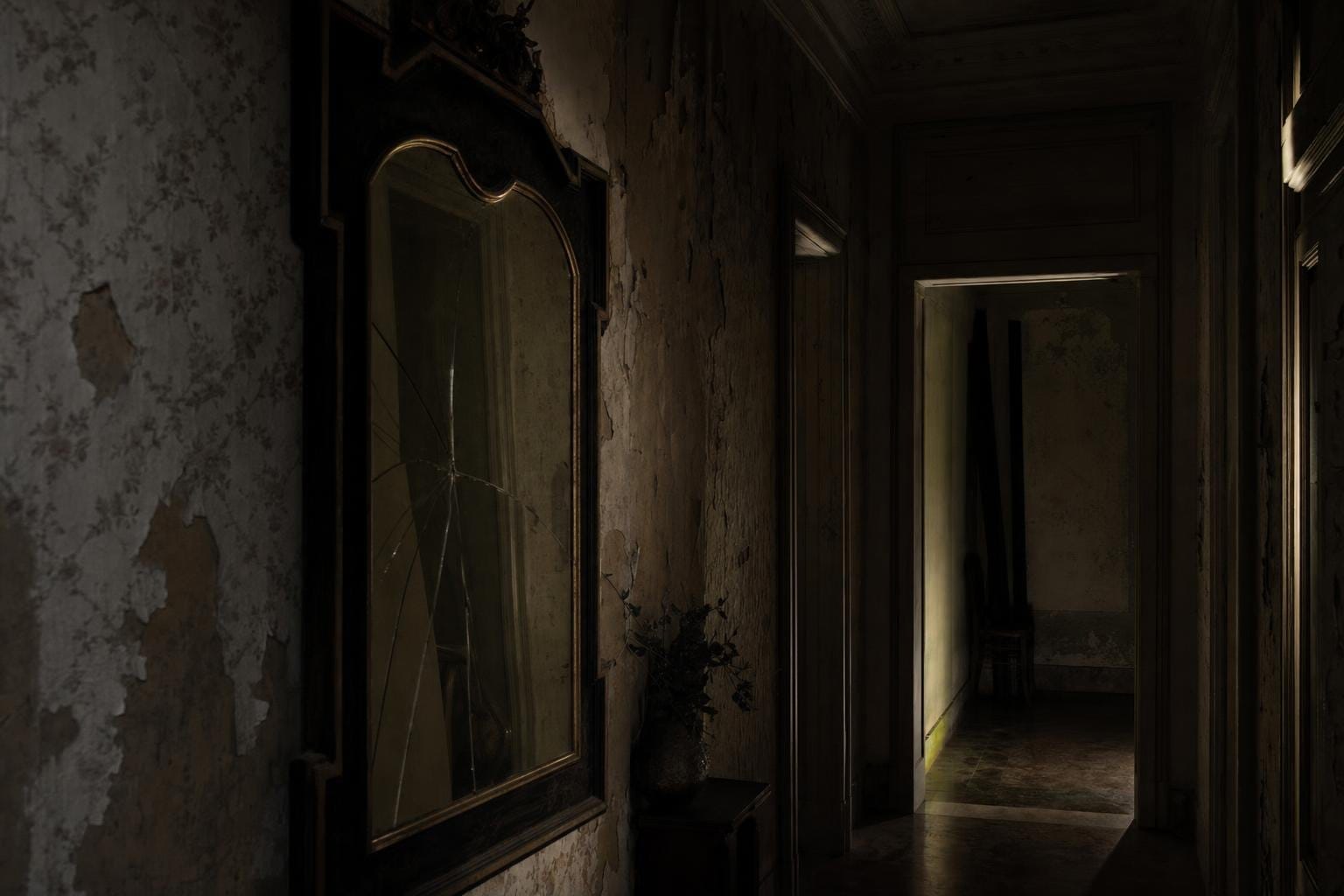
There is no health meter. The character’s condition shows on their body: after an attack they look battered, move slowly and breathe heavily. Mirrors placed around the house provide unlimited saves and one-time heals, cracking a little each time, a detail tied to the story and unsettling in its own right. They are not plentiful, so saving at every one is wise. Death brings a varied cutscene and a restart from the last mirror.
The difficulty is fair: challenging without being punishing, with lessons learned from each death. A few late sections frustrate with unexpected QTEs or situations that demand more diversion than evasion. Once understood, they are quickly overcome.
The verdict
At around six hours, Remothered is short, but given its price and how tense it is throughout, the length feels right, and it was planned as the first chapter of a trilogy. It is psychological horror in the true sense, unsettling through vulnerability and the darker side of people rather than monsters or the occult, and its realism is its strength. The pacing, from introduction to climax and epilogue, the motion-captured visuals and the hair-raising sound make it more an experience than a game. Horror fans should not miss it.
Questions readers ask
How long is Remothered: Tormented Fathers?
About six hours. It was planned as the first chapter of a trilogy.
Is there combat in Remothered: Tormented Fathers?
Very little. Defensive weapons are single-use and only stop a fatal attack. The game is built around evading the antagonist and distracting them with throwable items and music boxes.
How do you save and heal in Remothered: Tormented Fathers?
At mirrors placed around the house. They offer unlimited saves and a one-time heal each, and crack progressively as they are used.