Review
God of War (2018) Review, Spoiler-Free: Kratos Rebuilt as a Father
Santa Monica Studio kept Kratos's past and rebuilt everything else: story, camera, combat, controls and structure. It is one of the best games of its generation.
Released April 20, 2018Reviewed on PlayStation 4 (standard)Developer SIE Santa Monica StudioPublisher Sony Interactive EntertainmentPrice at launch $59.99 USD
God of War throws out almost everything the series used to be. Kratos’s history remains as the foundation; the story, art direction, combat, controls and structure have all been rebuilt. The result is one of the best games of the PlayStation 4 era and a high point for storytelling in games.
Atreus changes everything
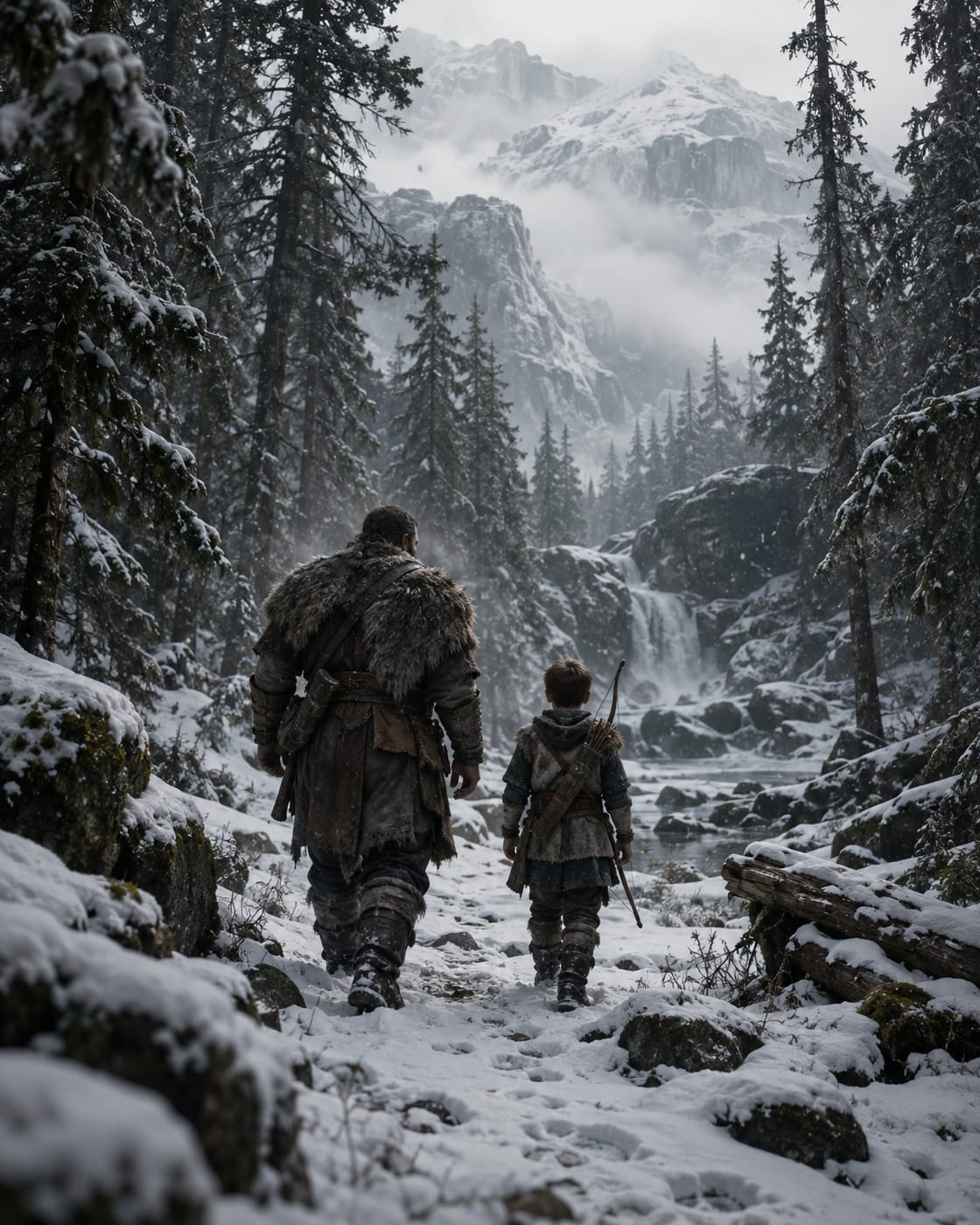
The earlier games had a one-dimensional Kratos: a single goal and a screaming, blood-soaked path to it. After God of War III the Ghost of Sparta has a new reason to keep going. He wants to teach his son, Atreus, not to repeat the mistakes that haunt him.
Atreus makes the series human. Kratos never explores Midgard alone; his son is beside him for the entire game. Escort companions are a gamble. For every Elizabeth in BioShock Infinite or Ellie in The Last of Us there is an Ashley from Resident Evil 4, the companion who drags the whole game down. Atreus lands firmly on the right side. He covers Kratos’s weaknesses, contributes to fights without blocking them, and has a strong claim to being the best AI companion yet.
Weight in every move
Next to the original trilogy, this Kratos feels heavy. The jump is gone. Attacks moved from the face buttons to the DualShock 4’s R1 and R2. The Blades of Chaos have given way to the icy Leviathan Axe, backed by a collapsible shield for blocks, parries and bashes, while Atreus adds arrows on command. Fights become deliberate brawls with forward momentum instead of crowd-clearing spins, and mastering them is deeply satisfying.
The axe is the star. Like Thor’s Mjölnir, it can be thrown, used to solve puzzles, and recalled to Kratos’s hand from across the map. Even climbing feels heavy. Where Uncharted or Tomb Raider let a character skip between handholds, here, with a boy on his back, Kratos has to look toward the next grip before he jumps.
A camera that never cuts
None of this would land as hard from the old pulled-back camera. The camera now sits just behind Kratos’s shoulder, and from the first scene to the credits it never cuts or fades to black. Films such as Birdman fake a single take with hidden cuts. God of War actually does it, and keeps it up across a whole adventure, which makes the story feel unbroken in a way only a game can.
Because the camera stays close, the interface does extra work. Health, rage (which fuels Spartan Rage) and three abilities sit at the bottom left; Atreus’s bow and his special ability sit on the right. When an enemy moves out of view, a coloured marker shows the direction and Atreus calls a warning: “To your right,” “Behind you.” Enemies flash yellow or red rings before their heavy attacks. It reads instantly.
The story
There are no spoilers here. The writing, the performances and the direction are the strongest parts of the game. Christopher Judge as Kratos and Sunny Suljic as Atreus have a father-son chemistry that feels completely real. The script builds on screen fathers such as Roth in Tomb Raider, Joel in The Last of Us and Rost in Horizon Zero Dawn, and goes further than all of them. The first hour is as strong as the fifteenth.
The small moments carry the most weight. One argument begins while the two row across the Lake of Nine. As it escalates, the game quietly takes the controls away and leaves Kratos to deliver his most important lesson in the middle of the water. Long-time fans expect huge set pieces, and they are here: the first hour has two that match the Poseidon fight at the start of God of War III, one a father-son scene and the other a fight with “The Stranger”. A quarrel in a rowing boat ends up just as memorable.
The game is also funny. Kratos is more nuanced, but his deadpan delivery survives, and now the cast mocks it. Brok and Sindri, the bickering dwarf blacksmiths, steal almost every scene they appear in.
Gear, skills and the open world
Those blacksmiths matter mechanically too. Kratos and Atreus get craftable armour sets with enhancement sockets, and the axe takes runic attacks and upgrades. Gear almost entirely drives Kratos’s stats (strength, runic power, defence and more), which combine into a level matched against enemy levels. Items use the familiar rarity colours, from green to purple. Hacksilver and materials pay for equipment, while XP unlocks new combat moves, arriving often enough to handle an enemy roster that includes poison and fire users, wolves, giants, flyers and phasing creatures. Ducking under a Traveler’s sword sweep, or watching a troll swing a stone pillar, never gets old.
The main path, the Journey, splits into sub-quests across a semi-open world full of optional areas. Favors are story side quests with caves, arena challenges and optional bosses. Labors are smaller tasks: kill a set of enemies, use a particular skill, find particular items. Treasure maps and artifacts fill the rest, and the characters remind Kratos about unfinished business without nagging.
Sound and detail
Bear McCreary’s score, heavy with brass and stern as its hero, fits perfectly. (McCreary also scored Battlestar Galactica and The Walking Dead.)
The density of detail is what separates God of War from very good AAA games. The bestiary is written in Atreus’s voice. Flying enemies have their own death animations. When a companion is telling a story on the boat and Kratos steps ashore, the story pauses, then resumes from the same point when he returns to the water.
The verdict
God of War brings wonder and colour to a series that used to see only red. Its central relationship lingers long after the credits, and its combat, camera and companion are all best in class.
The game mirrors its own story. Kratos, flawed and unsure, has to decide which parts of himself to pass on. Santa Monica faced the same choice and kept only the best of the old games: their scale and the shadow of Kratos’s past. Who it is for: anyone who has ever played an action game, including people who gave up on the series years ago. Who should hesitate: no one, really, except players who hate a slower, heavier combat rhythm.